The Opposition and Reconciliation of Mind and Flesh
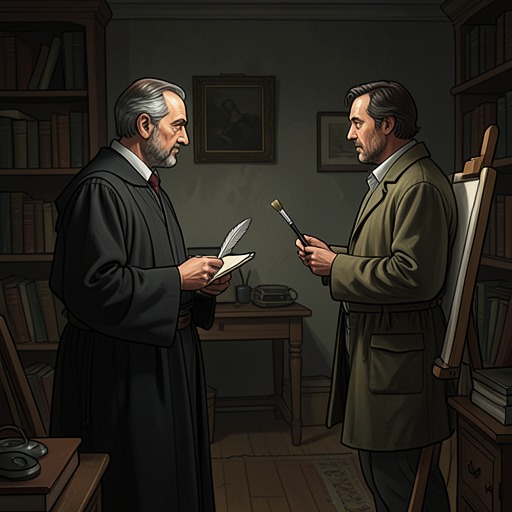
Narcissus and GoldmundThe Opposition and Reconciliation of Mind and Flesh is a central artistic and psychological idea in Goldmund’s understanding of himself. Mind and will belong to the paternal side of life, represented by Narcissus, while Goldmund’s own path leads toward the mother, desire, and death. Art does not simply resolve this division: it gives the two worlds a form in which they can meet, remain distinct, and sometimes conflict.
The Two Worlds
Goldmund recognizes that the wanderer’s life has shaped him through its maternal origin, its distance from law and abstract reason, and its intimacy with mortality. Yet mind and will remain within him. He is not simply the opposite of Narcissus; the two friends embody different orientations that Goldmund can now understand as complementary, though he cannot exchange one for the other. Narcissus is at home in the life of mind and will, whereas Goldmund knows through instinct and feeling that this is not his own home.
The difference between them becomes more than a contrast of personalities. Goldmund longs for Narcissus and can dream of him, but cannot reach him by becoming like him. He recognizes his friend as his counterpart, and the understanding is made visible in his statue of Saint John. The work gives outward form to a relationship whose deepest meaning is not achieved by erasing their difference.
The Maternal Principle and Mortality
Goldmund’s inward knowledge connects the mother with desire and death. Ecstasy carries the certainty of its own passing, while loneliness and melancholy may in turn be overtaken by desire and renewed openness to life. In this conception, death and ecstasy are one: neither bliss nor grief remains separate from the possibility of its reversal.
Eve becomes the name for this maternal source. She gives birth and also brings death; love and cruelty belong together in her image, as do life, the grave, and decay. As Goldmund carries the image within him, it grows into a parable and sacred symbol rather than remaining only a personal memory. His maternal orientation therefore binds sensual life to mortality, not as two unrelated subjects but as inseparable aspects of experience.
Art as Reconciliation
Goldmund’s sense of artistic vocation offers a way to join the domains of mind and blood without making them identical. Art may begin in sensuality and arrive at abstraction, or begin in a pure concept and end in the representation of living flesh. Its movement can cross the divide in either direction. The artist’s love of art may also turn to hatred, reflecting the difficulty of holding these contrary powers together.
For Goldmund, genuinely sublime art is more than technical virtuosity. He understands it as bearing a mysterious double character: masculine and feminine, instinctive and spiritual at once. The master’s Madonna exemplifies this union. Goldmund imagines that, if he succeeds in creating his own image of the mother, it will bear this double aspect even more fully. Art’s reconciliation is thus an aspiration and a demanding practice, not a settled escape from contradiction.
Contradiction as a Condition of Life
The concept finally extends beyond the opposition between the two friends. Goldmund sees division and contradiction as conditions through which life expands and flowers. Reason and sobriety are incomplete without knowledge of intoxication; sensuality is incomplete without the awareness of death; and love exists alongside the enduring conflict between the sexes. These pairings do not cancel one another. They expose the limits of any life organized around only one side of experience, and clarify why Goldmund’s artistic path must hold mind and blood in tension rather than choose one and discard the other.